◯ By Neural-Rift Inc.
Resonance One.
A quiet object, made to help you slow down.
◯ Section 02
The science of resonance.
The phenomenon
Every adult has a resonance frequency: a breathing rate, somewhere between 4.5 and 6.5 breaths per minute, at which the heart and breath fall into a measurable synchrony.
What happens in the body
The body's brake
The vagus nerve carries the slower signal.
Slow, extended exhales engage the vagal pathway, the principal route by which the nervous system slows the heart between beats.
Heart-rate variability
The space between heartbeats widens.
HRV is a marker of how readily the nervous system adapts.
At resonance
frequency, heart-rate oscillations reach their largest natural amplitude.
Sympathetic / parasympathetic
The body shifts toward rest.
Parasympathetic activity becomes more prominent.
The research
Nearly three decades of peer-reviewed work describe the resonance frequency model. Lehrer & Gevirtz (2014), writing in Frontiers in Psychology, set out how slow breathing engages the baroreflex and the vagal afferent pathway to the brain. Zaccaro et al. (2018), in Frontiers in Human Neuroscience, reviewed the autonomic and central nervous-system correlates of slow-paced breathing. Shaffer & Meehan (2020) outlined the resonance-frequency assessment protocol used across the field today. A 2023 meta-analysis in Scientific Reports by Fincham et al. reported small-to-moderate improvements in self-reported stress, anxiety, and low mood across randomised-controlled trials of breathwork in non-clinical populations.
◯ Section 03
The device.
How it works
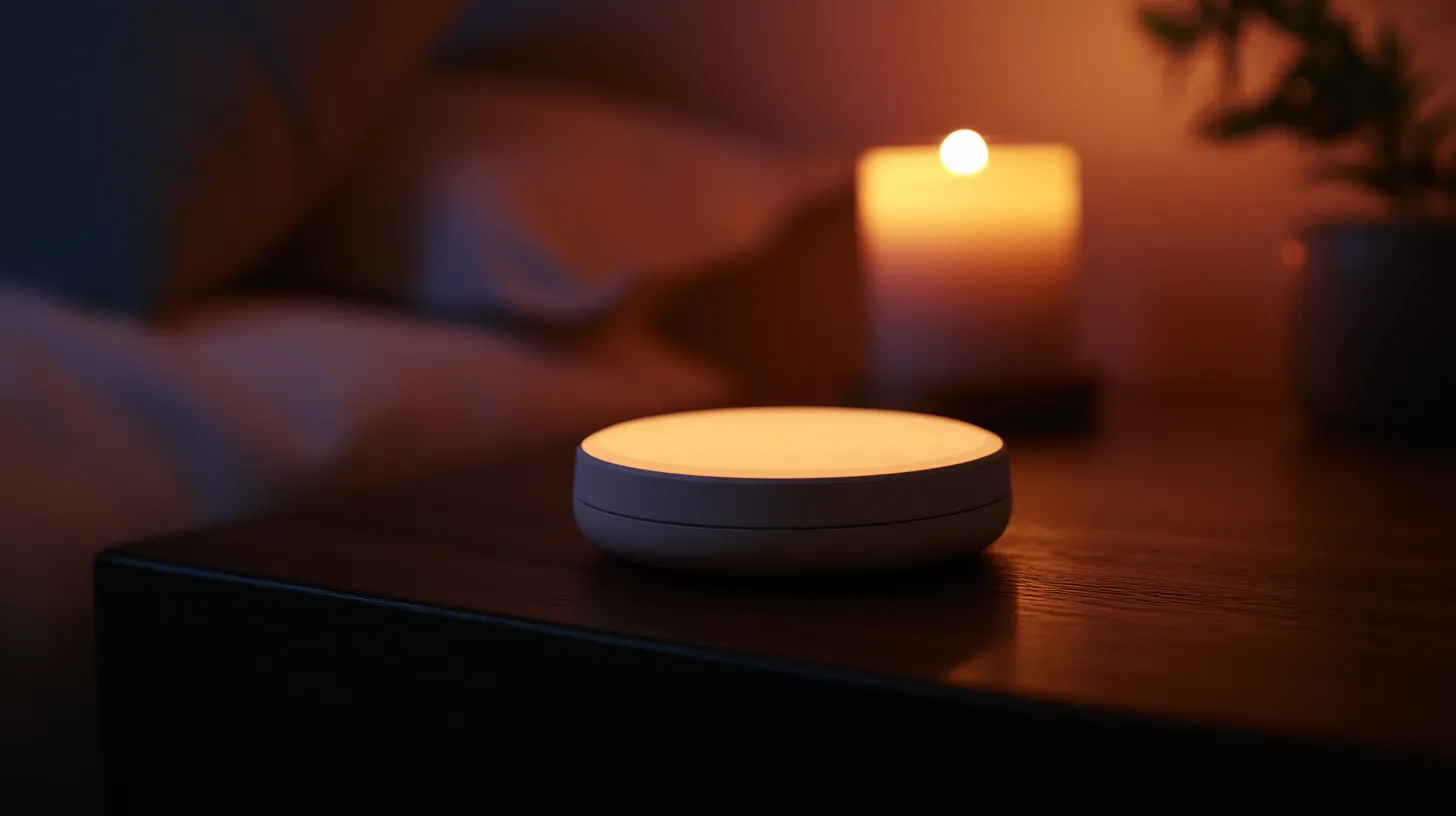
01 PLACE
Set it down.
Just place it and press and hold the button.
ResonanceOne fits naturally into your everyday spaces.
02 BREATHE
Follow the light.
Inhale as the light grows.
Exhale as it fades.
That's the whole practice.
03 DRIFT
Close your eyes.
Once you're synced, you don't need to watch the light anymore.
Close your eyes and keep breathing at your own pace.
Why an object
We believe an object is a physical reminder.
Like a joystick sitting on a shelf, its shape tells you what it's for.
ResonanceOne works the same way: pick it up, and you already know what to do.
References
- Lehrer, P. & Gevirtz, R. (2014). Heart rate variability biofeedback: how and why does it work? Frontiers in Psychology, 5:756. doi:10.3389/fpsyg.2014.00756
- Fincham, G. W. et al. (2023). Effect of breathwork on stress and mental health: a meta-analysis of randomised-controlled trials. Scientific Reports, 13:432. doi:10.1038/s41598-022-27247-y
- Zaccaro, A. et al. (2018). How breath-control can change your life. Frontiers in Human Neuroscience, 12:353. doi:10.3389/fnhum.2018.00353
- Shaffer, F. & Meehan, Z. M. (2020). A practical guide to resonance frequency assessment for heart rate variability biofeedback. Frontiers in Neuroscience, 14:570400. doi:10.3389/fnins.2020.570400
Resonance One is a general wellness product. It is not a medical device and is not intended to diagnose, treat, cure, or prevent any disease. Nothing on this page constitutes medical advice. Cited research describes slow-paced breathing in general; it does not evaluate this product.